Takaichi concludes her first official visit to India after the 16th India-Japan Annual Summit, with both countries announcing 16 major outcomes spanning economic security, AI, defence, energy, semiconductors, mobility, research and investment while reaffirming a shared Indo-Pacific vision
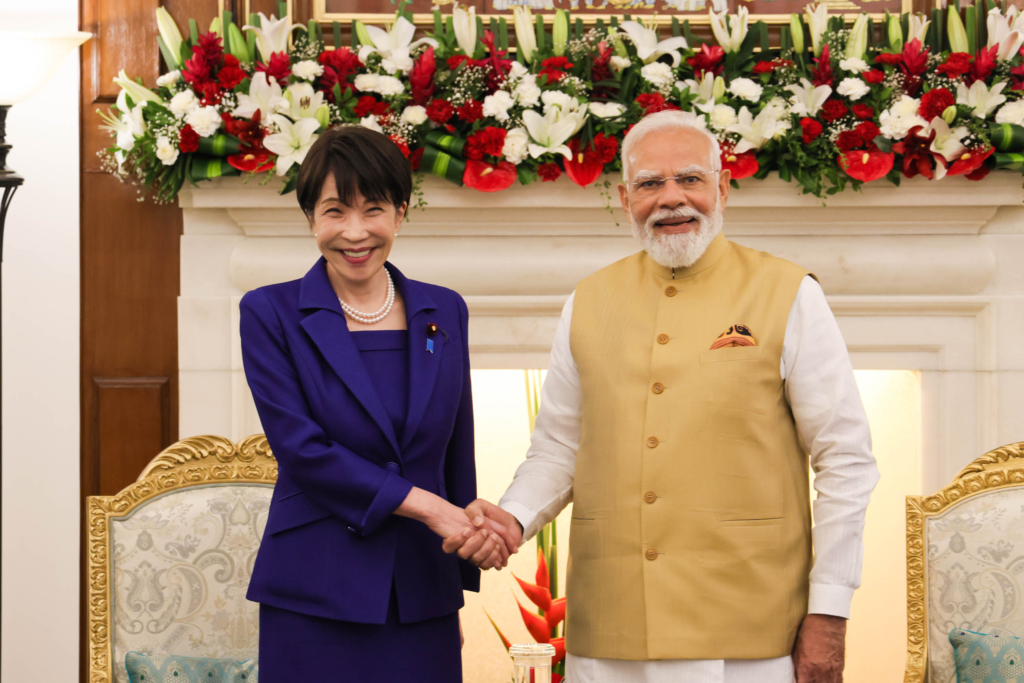
New Delhi: Japanese Prime Minister Sanae Takaichi departed India after concluding her first official visit to the country, marking the successful completion of the 16th India-Japan Annual Summit that significantly deepened the Special Strategic and Global Partnership between the two nations.
During the summit, Prime Minister Narendra Modi and Takaichi reviewed bilateral cooperation across economic security, trade, defence, innovation, critical technologies, clean energy, resilient supply chains and regional security. The leaders also reaffirmed their commitment to a Free and Open Indo-Pacific (FOIP) and closer cooperation through the Quad.
Following the meeting, both leaders agreed to deepen strategic cooperation by aligning Japan’s Free and Open Indo-Pacific (FOIP) vision with Prime Minister Modi’s MAHASAGAR initiative. Takaichi also announced progress in defence cooperation, based on the revised Joint Declaration on Security Cooperation, enhanced cooperation on petroleum stockpiling under “Power Asia” and the launch of the Japan-India CBG (Cooperative Biogas for Growth) Initiative to support India’s energy transition.
The Japanese Prime Minister also participated in the Japan-India Economic Forum alongside Prime Minister Modi. The forum brought together more than 150 Japanese companies and over 80 Indian firms, where 129 cooperation agreements were announced across manufacturing, energy, semiconductors, artificial intelligence, quantum technologies, startups and small and medium enterprises.
The Japa PM further noted that construction of the first biogas plant under the Japan-India CBG Initiative had commenced in Assam, calling it an example of expanding bilateral cooperation under the FOIP framework.
The summit concluded with 16 outcome documents spanning a wide range of strategic sectors. These included a Joint Declaration on Economic Security, joint statements on Artificial Intelligence, energy resilience, critical minerals and semiconductor cooperation, alongside initiatives to strengthen defence collaboration, digital and emerging technologies, clean energy, scientific research, healthcare, startup and SME partnerships, human resource development, people-to-people exchanges and institutional cooperation.
The leaders also endorsed the updated India-Japan Economic Security Fact Sheet 2.0 and agreed to accelerate collaboration across resilient supply chains, advanced manufacturing and innovation, further reinforcing the Special Strategic and Global Partnership as both countries prepare to mark the 75th anniversary of diplomatic relations in 2027.
The summit also advanced a roadmap to attract 10 trillion yen in Japanese investment into India over the next decade, reinforcing India-Japan ties as a key pillar of stability and economic growth in the Indo-Pacific.
Also Read: Manipur Driver’s Union Demands Immediate Repairs to NH-37: Flags Illegal Collections